Search Semantically — Large Language Models & Semantic Search
A modular, beginner-to-expert open-source course on how modern search works: from classic keyword matching to embeddings, dense retrieval, re-ranking, evaluation, and Retrieval-Augmented Generation (RAG).
This repository is a self-contained study companion for learning how Large Language Models (LLMs) transform information search. Every chapter pairs intuitive explanations (analogies, diagrams, worked examples) with runnable code and notebooks so you can learn the idea and build it.
The course uses an open-source-first toolkit — no paid API keys required — so anyone
can run everything locally. Repository: mdhabibi/llm-search-handbook.
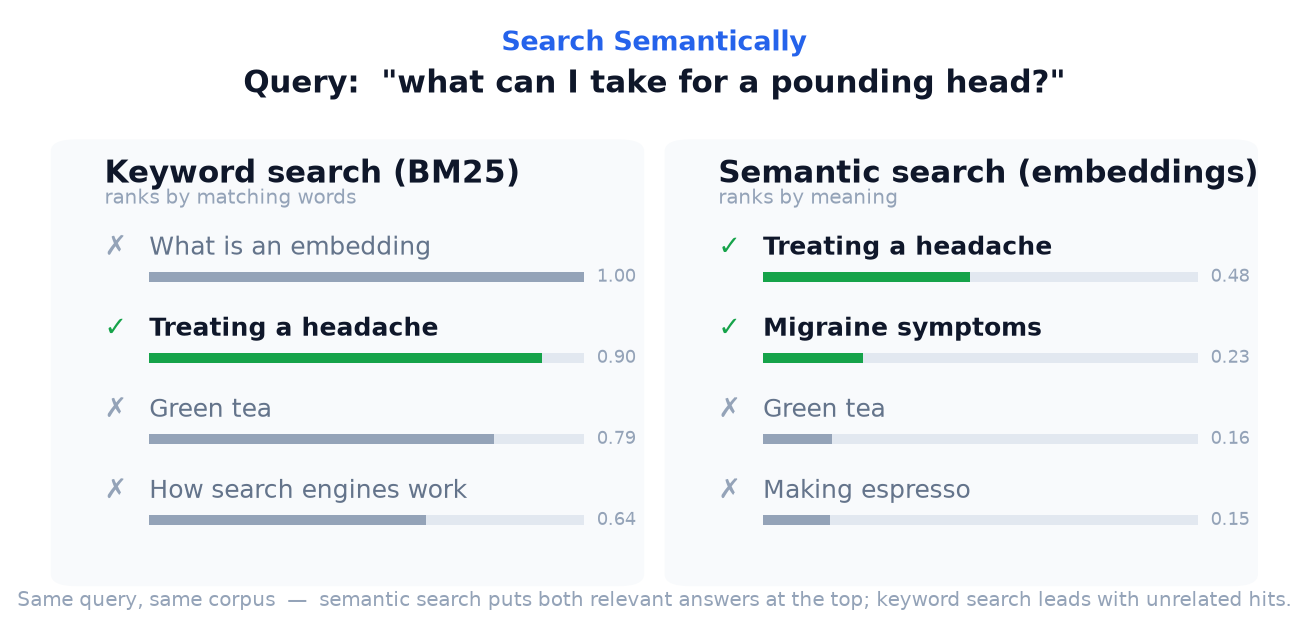
Keyword vs. semantic search on the same query and corpus — real output from this repo (BM25 + all-MiniLM), regenerate with scripts/make_demo.py.










🌐 Read the course online → — the full handbook as a fast, searchable website (light/dark, mobile-friendly, math rendered). No install needed.
📘 Download the e-book (PDF) → — all 14 chapters in one
colorful, ebook-formatted document (~69 pages) with a designed cover, table of contents,
callouts, typeset math, and an answers appendix. Perfect for reading offline or sharing.
(Rebuild it any time with ebook/build.sh.) Every page carries a footer and a light watermark with the author's name, and the PDF embeds author metadata.
⭐ If this course helps you, please star the repo — it helps other learners find it.
Who this is for
- Beginners — you know a little Python and want to understand how search engines and AI assistants actually find relevant information. Start at Chapter 0 and read in order.
- Intermediate developers — you want to build a real semantic search or RAG system. Skim the foundations, then dig into Chapters 5–11.
- Experts — each chapter ends with a Going Deeper section covering math, trade-offs, papers, and production concerns.
Difficulty is marked throughout:
| Badge | Meaning |
|---|---|
| 🟢 | Core idea — everyone should read |
| 🟡 | Intermediate — assumes the core idea |
| 🔴 | Advanced / optional deep dive |
What you will be able to do by the end
- Explain how search worked before LLMs (keyword / lexical search) and why it falls short.
- Turn text into numbers with embeddings and reason about vector space.
- Build a semantic (dense retrieval) search engine from scratch.
- Scale it with a vector database and approximate nearest-neighbor indexes.
- Sharpen results with re-ranking and hybrid search.
- Evaluate a search system properly (precision, recall, MRR, nDCG).
- Plug retrieval into an LLM to build a grounded RAG question-answering app.
- Ship a capstone project end to end.
How the repo is organized
llm-search-handbook/
├── README.md                       ← you are here
├── ROADMAP.md                      ← the full curriculum & learning path
├── GLOSSARY.md                     ← every key term, defined simply
├── Search-Semantically-ebook.pdf   ← the whole course as a colorful e-book
├── ebook/                          ← scripts to rebuild the PDF from the chapters
├── slides/                         ← one presentation deck (PDF) per chapter
├── setup/SETUP.md                  ← environment setup (one-time)
├── requirements.txt                ← Python dependencies
├── data/                           ← sample corpus + labeled eval set
├── src/                            ← reusable modules (corpus, semantic_search,
│                                     metrics, chunking, search_stack)
└── chapters/
    ├── 00-introduction/
    ├── 01-foundations-of-information-retrieval/
    ├── 02-keyword-lexical-search/
    ├── 03-text-to-vectors/
    ├── 04-embeddings-deep-dive/
    ├── 05-dense-retrieval-semantic-search/
    ├── 06-vector-databases-and-ann/
    ├── 07-reranking/
    ├── 08-hybrid-search/
    ├── 09-evaluating-search/
    ├── 10-rag-retrieval-augmented-generation/
    ├── 11-chunking-and-production-pipelines/
    ├── 12-advanced-topics/
    └── 13-capstone-project/
Every chapter folder follows the same modular layout:
NN-chapter-name/
├── README.md      ← the lesson: concepts, intuition, diagrams, worked examples
└── notebooks/     ← hands-on Jupyter notebooks you run yourself
Quick start
# 1. Clone and enter the repo
git clone https://github.com/mdhabibi/llm-search-handbook.git && cd llm-search-handbook

# 2. Create an environment and install dependencies
python -m venv .venv && source .venv/bin/activate   # Windows: .venv\Scripts\activate
pip install -r requirements.txt

# 3. Launch the notebooks
jupyter lab
Prefer zero setup? Every chapter notebook has an Open in Colab badge at the top — click it to run the lesson in your browser, no install required.
Full details (including troubleshooting and optional GPU notes) are in
setup/SETUP.md.
The learning path at a glance
| # | Chapter | You will learn | Notebook | Slides |
|---|---|---|---|---|
| 0 | Introduction | What semantic search is and how to use this repo | 📓 | 📊 |
| 1 | Foundations of Information Retrieval | The search problem before LLMs | 📓 | 📊 |
| 2 | Keyword / Lexical Search | TF-IDF, BM25, the inverted index | 📓 | 📊 |
| 3 | From Text to Vectors | Tokens, one-hot, bag-of-words → vectors | 📓 | 📊 |
| 4 | Embeddings Deep Dive | Word, sentence & document embeddings | 📓 | 📊 |
| 5 | Dense Retrieval & Semantic Search | Search by meaning | 📓 | 📊 |
| 6 | Vector Databases & ANN | Scaling to millions of vectors | 📓 | 📊 |
| 7 | Re-ranking | Cross-encoders to reorder results | 📓 | 📊 |
| 8 | Hybrid Search | Combining keyword + semantic | 📓 | 📊 |
| 9 | Evaluating Search | Precision, recall, MRR, nDCG | 📓 | 📊 |
| 10 | RAG | Grounded answers from an LLM | 📓 | 📊 |
| 11 | Chunking & Production Pipelines | Building it for real | 📓 | 📊 |
| 12 | Advanced Topics | ColBERT, multimodal, agentic RAG | 📓 | 📊 |
| 13 | Capstone Project | Build a full system | 📓 | 📊 |
See ROADMAP.md for the detailed outline of every chapter.
Status
All 14 chapters are complete 🟩 — every chapter has a full written lesson (intuition,
diagrams, worked examples) and a runnable notebook with our own code and data. Shared,
reusable modules live in src/:
corpus.py— sample corpus loader + tokenizersemantic_search.py— a minimal dense-retrieval engine (Ch 5)metrics.py— precision/recall/MRR/nDCG/MAP from scratch (Ch 9)chunking.py— fixed-size & sentence chunkers (Ch 11)search_stack.py— the full capstone stack: hybrid retrieve → re-rank → RAG → evaluate (Ch 13)
Every notebook's logic was verified; steps needing a model download (embeddings,
cross-encoder, LLM) run on your machine, while the offline logic is tested end to end.
The src/ metrics, chunking, and corpus helpers ship with a pytest suite run on
every push via GitHub Actions (Python 3.10–3.12).
Poster
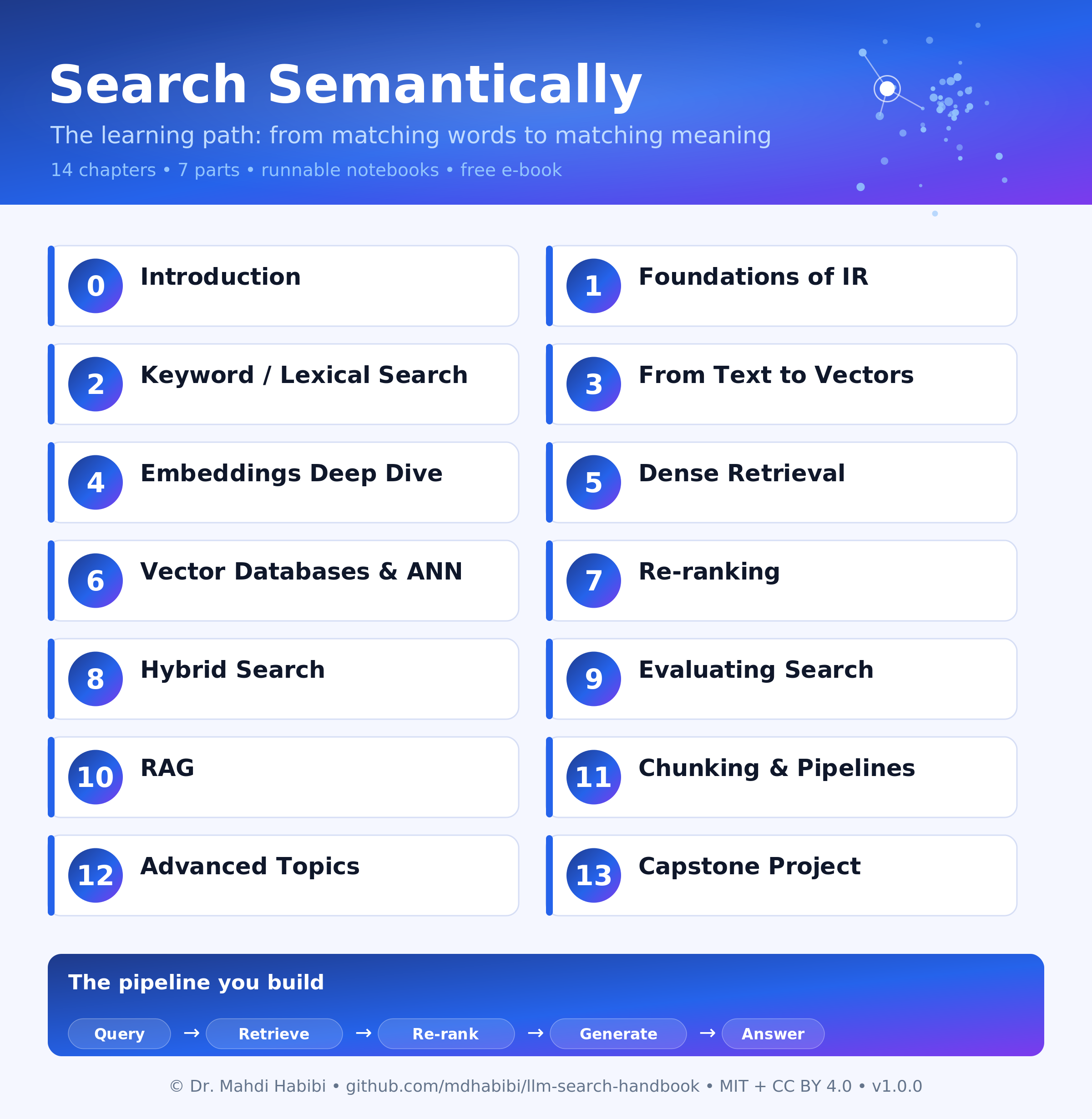
A one-page visual map of the whole course lives at
assets/poster.png — handy for sharing or printing.
Versioning
This project follows Semantic Versioning. The current release is
v1.0.0 (see CHANGELOG.md and VERSION).
Contributing
Contributions that make the course clearer, more correct, or more complete are welcome —
see CONTRIBUTING.md and our CODE_OF_CONDUCT.md.
Citation
If you use this course, please cite it (metadata in CITATION.cff):
Habibi, M. (2026). Search Semantically — Large Language Models & Semantic Search (v1.0.0). https://github.com/mdhabibi/llm-search-handbook
E-book attribution & protection
The e-book is authored by Dr. Mahdi Habibi. To keep attribution with the file:
- every page shows a footer (
© 2026 Dr. Mahdi Habibi · Search Semantically · v1.0.0) and a faint diagonal watermark; - the PDF embeds author/title metadata (visible in any reader's document properties);
- an optional
ebook/protect.shproduces a distribution copy (viaqpdf) that opens freely but disables copying and editing.
No PDF protection is unbreakable, but these measures ensure any shared copy is clearly attributed to the author.
License & attribution
This project is dual-licensed:
- Code (source files, notebooks, scripts) — MIT License.
- Content (chapter text, diagrams, glossary, the e-book) — CC BY 4.0.
The chapter text, worked examples, code and diagrams are original work. The course is inspired by — not copied from — the DeepLearning.AI × Cohere short course "Large Language Models with Semantic Search". The slide decks were assembled with presentation-generation tools from the chapter text. External papers and tools are credited in each chapter's References section.